
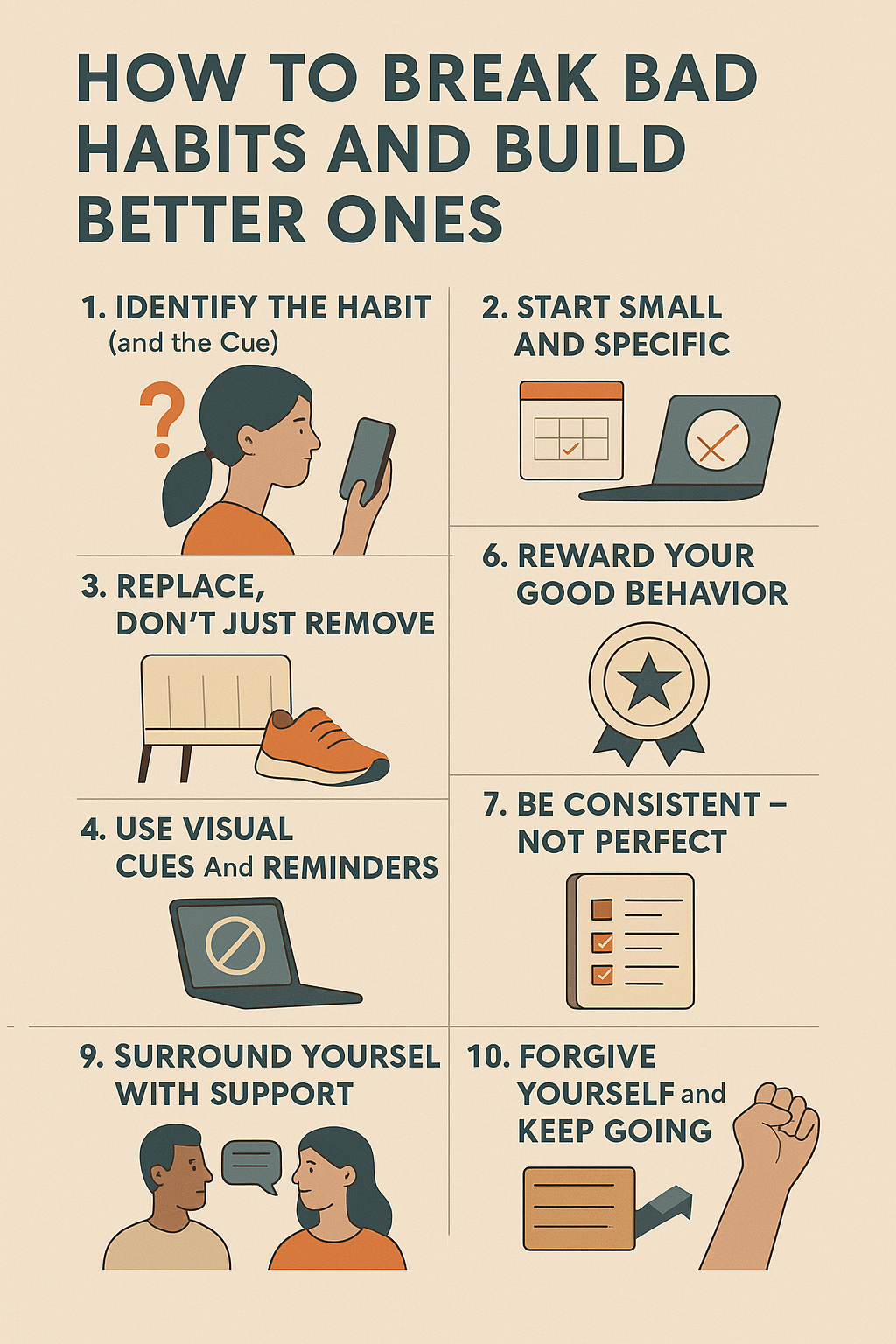
We all have habits we’d like to change — whether it’s procrastinating, mindless scrolling, eating junk food, or staying up too late. And we all have better habits we wish we could build — like exercising, reading, journaling, or getting organized.
The good news? You’re not stuck. Habits are learned behaviors, and that means they can be unlearned and replaced.
In this article, you’ll learn how habits really work, why they’re hard to break, and simple strategies to finally take control of your behavior — one small step at a time.
Why Habits Matter for Personal Growth
Habits are the foundation of your daily life. They shape:
- How you think
- How you feel
- What you do (and don’t do)
- How productive, healthy, and fulfilled you become
Your life is essentially the sum of your repeated actions. Change your habits — and you change your life.
How Habits Work: The Habit Loop
Every habit follows a predictable pattern:
- Cue – The trigger (time, place, emotion, routine)
- Craving – Your brain wants a reward (relief, pleasure, escape)
- Response – The habit you perform (action or thought)
- Reward – The payoff (stress relief, dopamine hit, etc.)
To break a bad habit or build a good one, you must interrupt or redesign this loop.
Step 1: Identify the Habit (and the Cue)
Start by getting specific:
- What’s the habit?
- When and where does it usually happen?
- What triggers it — stress, boredom, social settings?
Example:
Habit: Scrolling social media at night
Cue: Feeling tired or bored in bed
Reward: Mental escape or distraction
Awareness is the first step to change.
Step 2: Replace, Don’t Just Remove
Bad habits often fulfill a need. If you remove them without replacing them, your brain will search for another quick fix.
Instead, ask:
- “What’s the need behind this habit?”
- “What’s a healthier way to meet that need?”
Example:
Instead of scrolling → Try reading fiction or journaling to relax.
Sustainable change happens when you substitute the behavior, not just fight it.
Step 3: Start Small and Specific
Big changes fail because they’re too overwhelming.
Instead:
- Break habits down into tiny actions
- Anchor them to something you already do
- Make them so easy that your brain can’t resist
Examples:
- Instead of “exercise more” → Start with 5 minutes of stretching after coffee
- Instead of “eat healthier” → Swap chips for fruit once a day
- Instead of “stop procrastinating” → Set a 10-minute timer to begin
Small wins create momentum and confidence.
Step 4: Use Visual Cues and Reminders
Make your good habits obvious:
- Lay out your workout clothes the night before
- Place your journal next to your toothbrush
- Use sticky notes or habit tracker apps
Your environment should remind you — and make it easier to do the right thing.
Step 5: Make Bad Habits Inconvenient
The harder it is to perform a bad habit, the less likely you’ll do it.
Try this:
- Delete apps or log out after each use
- Keep snacks or cigarettes out of reach
- Move your TV remote to another room
- Use website blockers during work hours
Friction disrupts the loop.
Step 6: Reward Your Good Behavior
Your brain needs a reason to repeat a behavior.
Try:
- Checking off a habit tracker
- Saying “good job” out loud to yourself
- Listening to a favorite song after finishing a task
- Reflecting on how good it feels to follow through
Even small rewards build powerful motivation.
Step 7: Be Consistent — Not Perfect
You don’t have to be perfect. You just need to show up more often than not.
Use the “never miss twice” rule:
If you skip one day, it’s okay — but don’t skip the next one.
Habit change is a long game. Progress beats perfection.
Step 8: Track Your Progress
Measurement keeps you honest — and motivated.
You can:
- Use a paper habit tracker or app
- Mark an X on a calendar for every day you follow through
- Reflect weekly on what worked, what didn’t, and how to adjust
What gets tracked gets improved.
Step 9: Surround Yourself With Support
Habits are contagious — both good and bad.
- Share your habit goals with a friend
- Join a challenge or group focused on that habit
- Spend time with people who inspire the version of you you’re becoming
You don’t have to do it alone.
Step 10: Forgive Yourself and Keep Going
You will mess up. Everyone does. The key is not to quit.
When you slip:
- Don’t spiral into guilt or shame
- Review the trigger and adjust your approach
- Get back on track as soon as possible
Compassion creates resilience — and resilience builds better habits.
Final Thought: Your Habits Are Your Superpower
You don’t need extreme willpower. You need small, steady actions.
Habits aren’t who you are — they’re what you do repeatedly.
Start small. Stay consistent. Give yourself time.
Because the version of you you want to become?
They’re already within reach — one habit at a time.
Deixe um comentário